Nepalese students and Indian teacher win Oxford Saïd Global Climate Tech Challenge 2026
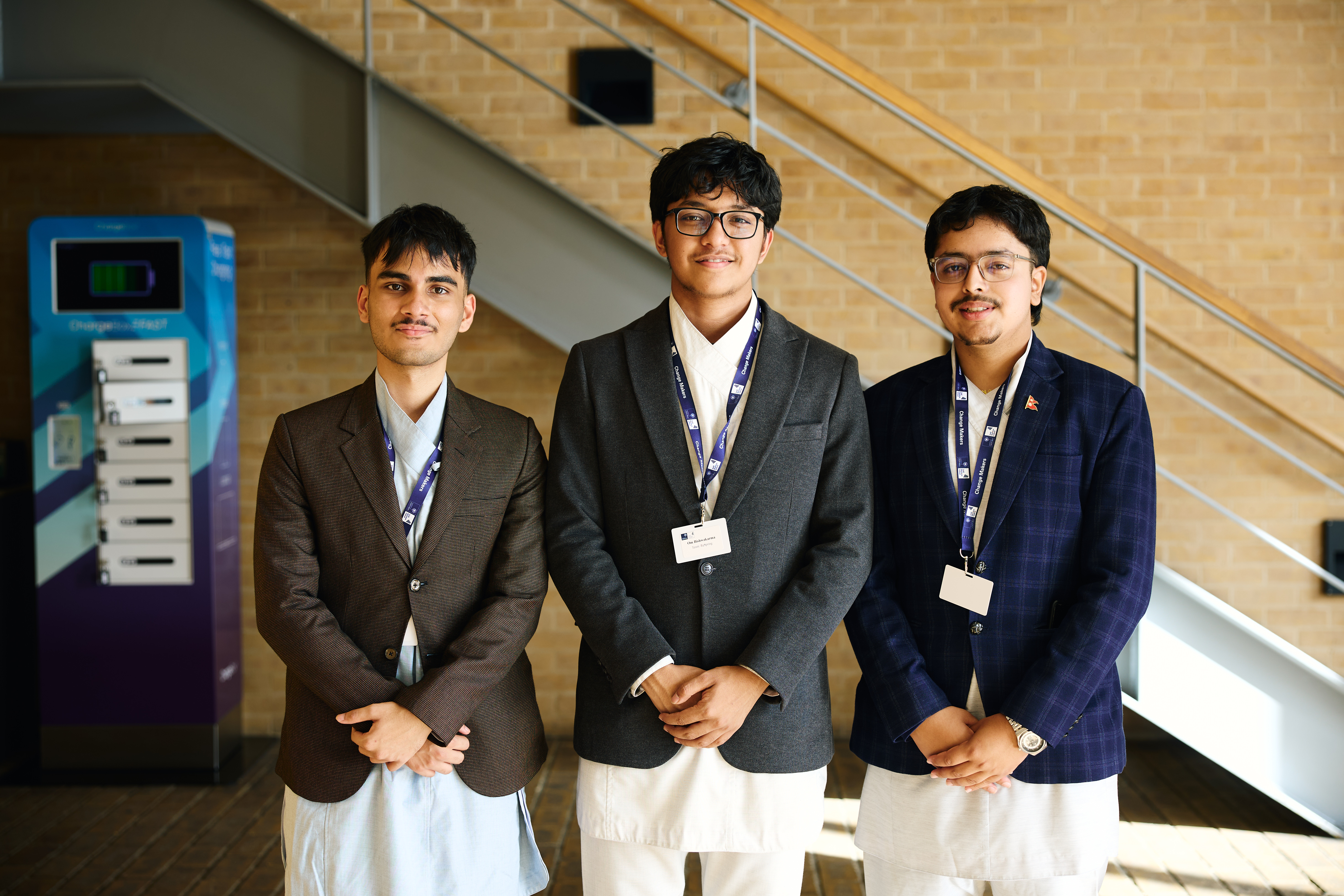
Innovative projects tackling water scarcity and menstrual waste take top honours at international finals in Oxford
A student team from Nepal using satellite data to help communities tackle water scarcity, and an Indian teacher connecting climate education with menstrual health and waste reduction have been named winners of the Oxford Saïd Global Climate Tech Challenge 2026. The finals, held at Saïd Business School, University of Oxford on Sunday 25 October, brought together five student teams and five teachers from nine countries to present innovative responses to climate-related challenges.
Team ReSpring from Motherland Secondary School in Nepal, won the student competition with their 'spring revival grid' which uses freely available satellite data to help identify potentially suitable locations for groundwater recharge ponds. Mariya Shah, from Prerna Girls School, Study Hall Educational Foundation in Lucknow, India, won the teacher category with 'Break the silence: Zero waste periods to combat climate change”, a teaching programme combining environmental science, period education, waste reduction and community action.
Technology tackling water scarcity
Team ReSpring's project focussed on communities in Nepal's mid-hills that depend heavily on natural springs for their water. Its model combined satellite data on slope, soil moisture and vegetation trends to rank possible locations for recharge ponds, helping communities and organisations make better-informed decisions about where interventions could be most effective. Potential sites would still require field verification.
Pegram Harrison, Senior Fellow in Entrepreneurship and Academic Director for Youth Education at Saïd Business School and Lead Judge, said:
“What I find interesting about ReSpring's approach is the emphasis on identifying where interventions might be most effective. Using satellite information to help determine suitable locations for groundwater recharge ponds is an example of technology supporting better local decision-making.” The winning student team, ReSpring receives a full scholarship to an Oxford Saïd Youth Education summer school in 2027
Connecting climate education with community action
Mariya's winning lesson plan explored the environmental impacts associated with menstrual products alongside climate change, plastic pollution and lower-waste alternatives. Students move from classroom learning to community research and awareness activities, including posters, conversations and street theatre.
Pegram Harrison said “Her approach reminds us that environmental education cannot always be separated from social and cultural realities. If we want students to influence behaviour, we must help them develop not only scientific understanding, but also the confidence and sensitivity to communicate with others.” Mariya will receive a place on an Oxford Saïd programme in Oxford in 2027.
Global finalists recognised
Maryam Muddesar from Riyadh School, Misk City in Saudi Arabia, was named runner-up in the teacher competition. In the student competition, Team Ankura Solutions, from Orange County School of the Arts in the United States, was named first runner-up, with Team Sixth Hour, from Brighton College in the UK, taking second runner-up. Other finalists came from Azerbaijan, India, Turkey, the UAE and Vietnam, alongside the winning entries from Nepal and India. The live stream of the Finals recorded 2,366 YouTube views.
Speaking at the opening, Jo Fawkes, Director of Global Inclusion and Youth Education at Saïd Business School, said:
“Young people have something valuable to contribute to conversations about our collective future, not simply at some distant point when they have completed their education, but today.”
She added:
“Teachers do far more than communicate knowledge. They nurture curiosity. They encourage students to ask questions. They help young people discover that their ideas deserve to be heard.”
Ideas with potential for impact
The Oxford Saïd Global Climate Tech Challenge is free to enter and invites high-school students and teachers worldwide to use technology, creativity and problem-solving to generate solutions and lesson plans addressing air pollution, extreme weather, food security, biodiversity and water scarcity.
Reflecting on the diversity of approaches presented at the Finals, Pegram Harrison said: “Climate change is an extraordinary collection of interconnected challenges, each shaped by geography, economics, infrastructure, institutions and human behaviour.”
He encouraged finalists to view Oxford as a step in developing their ideas rather than the end of the journey: “The real significance of this Challenge lies in what happens next. An idea does not need to emerge from this room fully formed. The work of innovation is rarely a straight line from problem to solution.”
ENDS
For more infomation or interviews please contact [email protected]
This press release was distributed by ResponseSource Press Release Wire on behalf of BlueSky Education in the following categories: Environment & Nature, Education & Human Resources, for more information visit https://pressreleasewire.responsesource.com/about.