The Next Business Metric: How Do You Measure Climate Resilience?
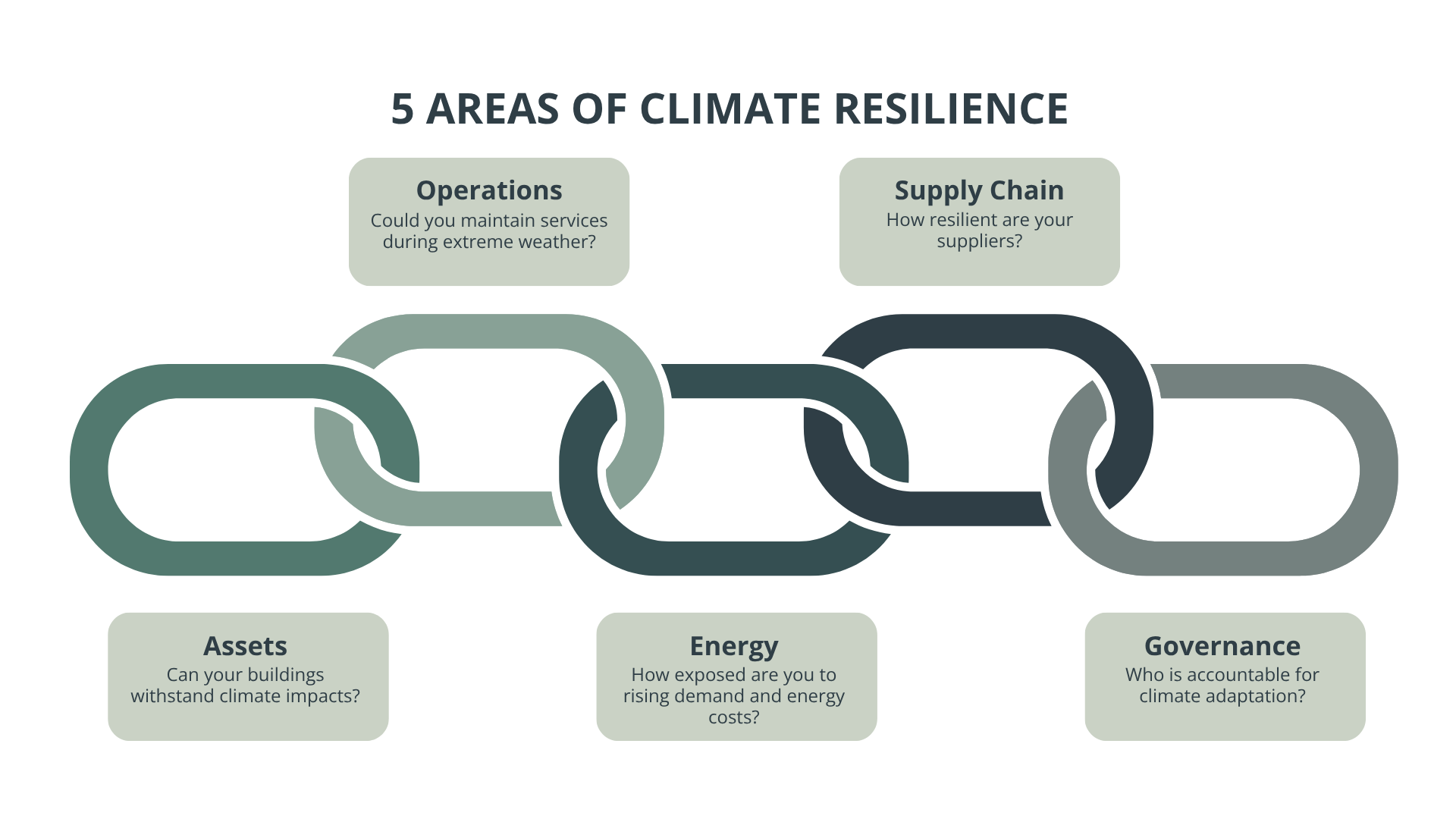
Ask most organisations for their carbon footprint and they can give you a figure. Ask how exposed they are to overheating, flooding, energy disruption or a supply chain shock, and the answer is far less certain.
That gap is becoming a strategic problem. Over the past decade, businesses have become genuinely good at measuring their impact on the climate, driven by regulation, investor pressure and the maturing discipline of sustainability reporting. What far fewer can quantify is what the climate’s impact is on them.
As heatwaves, flooding and extreme weather become more frequent and more costly, that second question is becoming as important as the first. And it points to a metric most boards don’t yet track, climate resilience.
Why resilience resists a single number
Carbon lends itself to measurement because it can be distilled into one comparable figure. Resilience can’t. It is spread across an organisation’s buildings, its operations, its energy use, its suppliers and its governance. It generally only becomes visible when something goes wrong.
That complexity is precisely why it gets overlooked. But it can be assessed, benchmarked and improved, provided organisations are willing to look across five connected areas.
• Physical assets. How exposed are buildings and infrastructure to flooding, overheating and water stress? A site that overheats every summer is not a maintenance issue; it is a resilience one.
• Operations. Extreme weather disrupts productivity long before it damages a building. Hours lost, services interrupted and staff unable to work in the heat are all measurable signals.
• Energy. This is where resilience becomes tangible. Rising temperatures drive cooling demand, push up peak electricity use and increase exposure to price volatility. Organisations with mature energy management are far better placed to anticipate and absorb these pressures than those flying blind.
• Supply chain. Many businesses now understand their suppliers’ emissions but know little about their suppliers’ physical exposure to climate disruption, or how quickly an alternative could be sourced.
• Governance. Increasingly a board-level concern: are climate risks on the corporate risk register, and is anyone actually accountable for adaptation?
From environmental issue to risk management
Reframed this way, climate adaptation stops being an environmental footnote and becomes a question of business continuity, operational performance and long-term risk. It sits far closer to the finance director’s world than the sustainability teams.
There is a natural next step. Just as the disciplines of carbon accounting and mandatory frameworks such as SECR gave organisations a structured way to measure emissions, a climate resilience scorecard that rates preparedness across those five areas could give them a structured way to measure exposure. It doesn’t need to be perfect to be valuable, it just needs to make an invisible risk visible.
The takeaway
Most organisations can tell you their carbon footprint. Far fewer can tell you whether they could keep operating through a 40°C week, a flooded distribution centre or a supplier knocked offline by extreme weather. As those events become more frequent, resilience may prove to be as important a business metric as emissions.
The organisations that thrive won’t simply be the ones with the lowest carbon figures. They’ll be the ones that assess, monitor and strengthen their resilience with the same rigour they already apply to financial and sustainability performance. Increasingly, that is conversation businesses are not exclusively having with their facilities teams, but with their boards, and, often, with the sustainability consultants UK firms now rely on to translate climate risk into commercial terms.
ENDS
Notes to Editors
For further information, please contact:
Pauline Scoins - Marketing and PR Executive
TEAM Energy
Phone: +44 (0) 01908 690018 Ext 204
Email: [email protected]
EDW House, Radian Court, Knowlhill, Milton Keynes, MK5 8PJ
www.teamenergy.com
About TEAM
TEAM is an energy and sustainability consultancy. It helps organisations with large energy estates reduce consumption and carbon emissions to save money and meet commercial and compliance targets on their journey to net zero.
Founded in 1985, it has a long history of helping customers navigate changing definitions and certification standards. TEAM Energy is an Employee Ownership Trust (EOT), with employees having a direct stake in its customers’ success.
This press release was distributed by ResponseSource Press Release Wire on behalf of Team Energy in the following categories: Environment & Nature, Business & Finance, Manufacturing, Engineering & Energy, for more information visit https://pressreleasewire.responsesource.com/about.